
Alternative Investment Strategies for Accredited Investors
Building Durable Wealth through Structural Allocation & Disciplined Stewardship
By Edwin D. Epperson III, Founder & Fund Manager, Blue Bay Fund I


More about Edwin
Edwin D. Epperson III is the Founder and Fund Manager of Blue Bay Fund I, a private real estate credit fund focused on senior secured lending and capital preservation strategies for accredited investors.
A former U.S. Army Green Beret, he applies disciplined risk evaluation, structured underwriting standards, and conservative capital stewardship to private credit investing.
Alternative investment strategies are no longer optional considerations for sophisticated portfolios. They are structural decisions.
As volatility reshapes public markets and traditional income sources become less predictable, accredited investors face a defining question:
How should capital be positioned to generate reliable income while preserving principal?
That is the lens through which alternative investment strategies must be evaluated.
The quality of allocation decisions ultimately determines the durability of wealth.
Defining Alternative Investment Strategies
Alternative investment strategies refer to private or structured investments outside publicly traded stocks and bonds. These may include private equity, venture capital, hedge funds, real estate equity, structured notes, and private debt.
While grouped together, these strategies differ significantly in their liquidity profiles, volatility, capital structure, and return drivers.
Some rely on valuation growth and exit timing. Others rely on contractual income and secured repayment structures.
For accredited investors, that distinction is not academic. It is strategic.
The question is not whether to allocate to alternatives. The question is which alternative investment strategies align with long-term income objectives and capital preservation standards.
Accredited investors operate from a position of responsibility. Allocation decisions reflect long-term planning and disciplined capital management.
Alternative investment strategies should be evaluated by the same standard.
Not all alternatives deserve capital. Only those aligned with structure and purpose do.
Growth-Oriented Alternatives vs. Secured Income Strategies
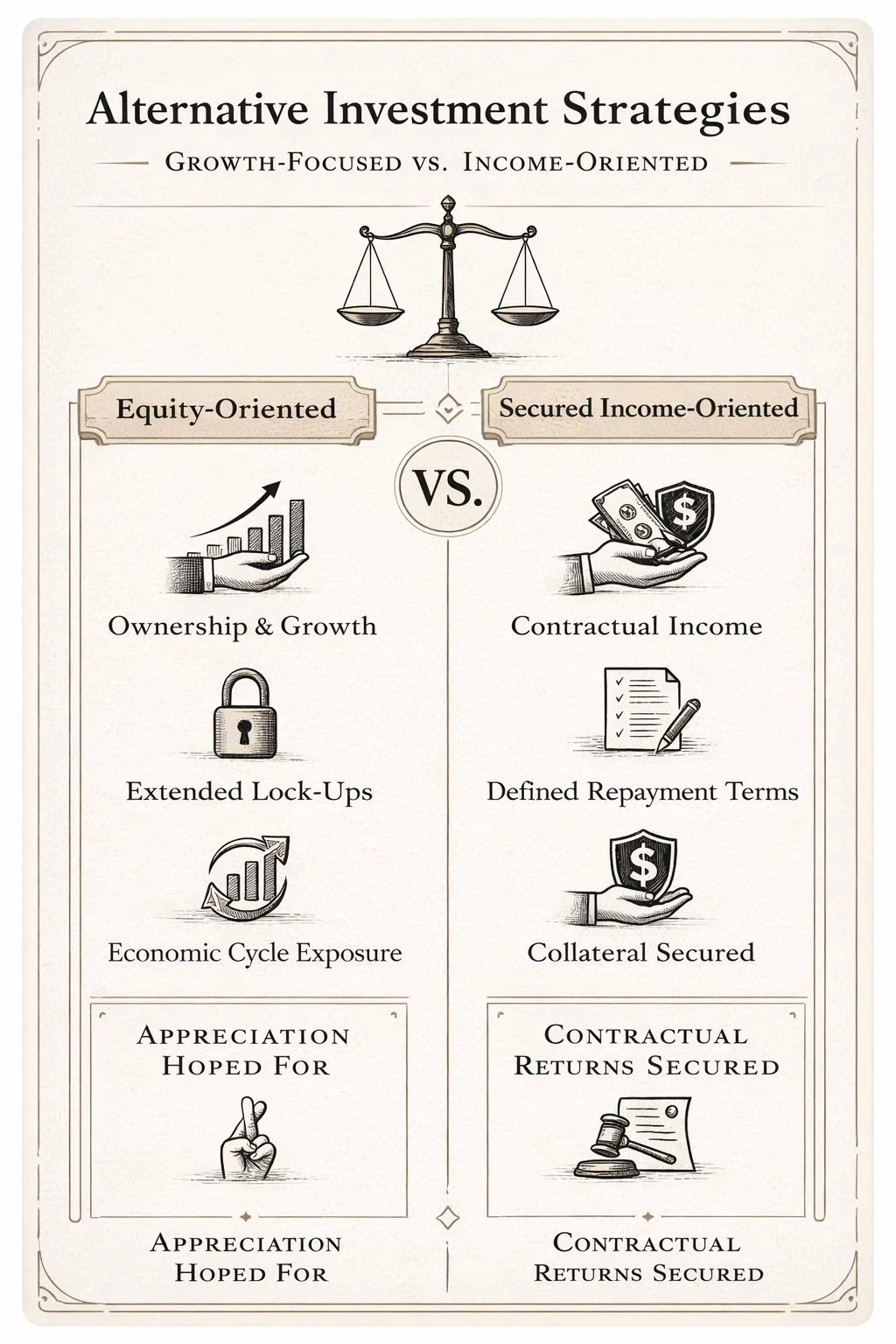
Many alternative investment strategies are growth oriented. Private equity and venture capital pursue appreciation through ownership and operational transformation.
These approaches can generate upside but often involve extended lock-up periods, limited liquidity, and exposure to economic cycles.
Secured income-oriented strategies operate differently. Secured private credit emphasizes contractual interest income, defined repayment terms, and collateral-secured positions.
For investors prioritizing predictable passive income and capital preservation, secured private credit represents a structurally distinct alternative investment strategy.
Structure determines whether returns are hoped for or contractually earned.
The Role of Secured Private Credit in Alternative Allocations
Secured private credit has expanded as traditional banks have reduced balance sheet lending and private capital has stepped into the funding gap.
Within secured private credit strategies, capital is deployed through senior secured lending to private companies or real estate projects. Returns are generated primarily through contractual interest payments rather than market valuation growth.
Disciplined secured private credit relies on conservative underwriting, defined term structures, prudent loan-to-value ratios, and ongoing collateral oversight.
Because lenders maintain priority over equity holders, secured private credit can offer enhanced downside structure.
When capital preservation matters, structure becomes decisive.
In uncertain markets, priority in the capital stack is not a preference. It is protection.
Capital Preservation as a Structural Principle

Capital preservation within alternative investment strategies is not automatic. It is engineered.
Effective risk management requires diversification, senior secured positioning, conservative underwriting, and ongoing collateral monitoring.
Yield without structure introduces fragility. Structure without discipline introduces complacency.
Sustainable alternative investing demands both.
Preservation of capital is rarely the result of luck. It is the result of consistent discipline.
Blue Bay Fund I and Secured Alternative Investment Strategies
Blue Bay Fund I operates within the secured private credit segment of alternative investment strategies. The fund emphasizes senior secured lending, collateral-supported structures, disciplined underwriting, and systematic risk oversight.
Blue Bay Fund I focuses on senior secured lending within the private real estate credit market. Capital is deployed through collateral-secured loan structures, typically structured with conservative loan-to-value parameters and clearly defined repayment terms. The strategy prioritizes income generated through contractual interest payments while maintaining a senior position in the capital stack to reinforce downside protection.
The objective is direct and measurable: generate consistent passive income while structuring capital in secured positions designed to withstand economic stress.
Rather than pursuing equity-style appreciation, Blue Bay Fund I focuses on secured credit structures where contractual income, repayment priority, and asset security define the investment thesis.
This approach is not designed for speculation. It is designed for disciplined allocation.
For accredited investors who value structure, clarity, and income reliability, secured private credit aligns strategy and objective.
Clarity in structure allows confidence in allocation.
The Blue Bay Fund I Philosophy

Blue Bay Fund I Investment Strategy at a Glance
Operates in the secured private credit segment of alternative investments
Focuses on senior secured real estate lending
Loans are backed by real estate collateral
Uses conservative loan-to-value (LTV) structures
Maintains senior position in the capital stack for downside protection
Generates passive income through contractual interest payments
Emphasizes disciplined underwriting and risk oversight
Designed for capital preservation and income reliability for accredited investors
Blue Bay Fund I operates within the secured private credit segment of alternative investment strategies. The fund emphasizes senior secured lending, collateral-supported structures, disciplined underwriting, and systematic risk oversight.
Blue Bay Fund I focuses on senior secured lending within the private real estate credit market. Capital is deployed through collateral-secured loan structures, typically structured with conservative loan-to-value parameters and clearly defined repayment terms. The strategy prioritizes income generated through contractual interest payments while maintaining senior position in the capital stack to reinforce downside protection.
The objective is direct and measurable: generate consistent passive income while structuring capital in secured positions designed to withstand economic stress.
Rather than pursuing equity-style appreciation, Blue Bay Fund I focuses on secured credit structures where contractual income, repayment priority, and asset security define the investment thesis.
This approach is not designed for speculation. It is designed for disciplined allocation.
For accredited investors who value structure, clarity, and income reliability, secured private credit provides alignment between strategy and objective.
Clarity in structure allows confidence in allocation.
For Investors Evaluating Alternative Investment Strategies
Sophisticated investors evaluating alternative investment strategies should look beyond projected returns.
They should examine capital structure positioning, collateral quality, underwriting standards, liquidity constraints, and manager discipline.
How income is generated matters.
How principal is protected matters more.
Blue Bay Fund I provides qualified accredited investors with a comprehensive investor brief outlining its secured real estate credit strategy, underwriting standards, portfolio construction discipline, and capital stack positioning.
For investors who allocate based on structure rather than projections, reviewing the framework is the appropriate next step.
Request the Investor Brief to Review the Secured Strategy in Detail.
Frequently Asked Questions About Alternative Investment Strategies
What are alternative investment strategies?
Alternative investment strategies refer to private-market or structured investment approaches outside traditional publicly traded equities and bonds. These strategies vary widely in risk profile, liquidity, and return drivers. The critical distinction lies in structure — whether returns are dependent on valuation growth or defined through contractual income and secured positioning.
Are alternative investment strategies inherently higher risk?
Risk is not determined by the label “alternative.” It is determined by structure, underwriting discipline, capital stack position, and liquidity terms. Growth-oriented equity strategies may carry higher volatility and longer lockups. Secured private credit strategies, by contrast, emphasize defined repayment terms, collateral protection, and senior positioning within the capital structure.
How do income-focused alternative investment strategies generate returns?
Income-focused alternative investment strategies generate returns primarily through contractual cash flows. In secured private credit, income is defined at origination through negotiated interest rates and repayment schedules. Returns are driven by structure and enforcement, not by speculative appreciation.
What differentiates private equity from secured private credit?
Private equity allocates capital as ownership, seeking returns through operational growth and exit events. Secured private credit allocates capital as a lender, maintaining a priority claim on assets and generating income through interest payments. The difference is structural: equity participates in upside and bears first-loss risk; secured credit prioritizes repayment and downside protection.
Who qualifies as an accredited investor?
Accredited investor status is defined by regulatory thresholds intended to ensure participants have the financial capacity to engage in private markets. Qualification typically includes individuals with net worth exceeding $1 million excluding primary residence, or annual income above $200,000 individually, or $300,000 jointly, with reasonable expectation of continuation.
What should sophisticated investors evaluate before allocating to alternative investment strategies?
Sophisticated investors evaluate structure before projected returns. Key considerations include underwriting standards, collateral quality, capital stack positioning, diversification framework, liquidity constraints, and manager discipline. A well-structured strategy defines how income is generated and how principal is protected under stress.
Conclusion: Intentional Allocation
Alternative investment strategies range from speculative growth vehicles to structured, income-oriented secured credit.
For accredited investors prioritizing passive income and capital preservation, secured private credit represents a deliberate strategy within private markets.
Contractual income. Senior secured positioning. Conservative underwriting.
In alternative investing, structure determines outcome.
For disciplined investors, secured private credit is not an experiment. It is an intentional allocation.
Over time, intentional allocations compound more reliably than opportunistic bets.
Intentional allocations compound more reliably than opportunistic bets.
Alternative investment strategies vary widely in structure and risk.
If secured private real estate credit aligned with disciplined underwriting standards fits your allocation criteria, we invite you to review the complete fund overview.

Edwin D. Epperson III,
Manager & CEO
Soli Deo Gloria
