
How to Invest in Private Credit for Wealth Preservation

Professional Photography by Carography Studios
INVEST IN PRIVATE CREDIT
Private credit offers accredited investors a distinct approach to wealth preservation through privately negotiated loans and credit instruments outside public markets. These investments create value via structural protections: seniority, collateral, and predictable cash flows, supporting steady income and reducing downside risk. This guide explores private credit, its benefits, access routes, and Blue Bay Fund I's real estate-secured strategy.
What is private credit and how does it support wealth preservation?
Private credit refers to loans made directly to borrowers outside public bond markets. It supports wealth preservation through contractual cash flows and structural protections like collateral and seniority. Secured by assets, real estate, lenders hold a first claim if a borrower defaults, reducing potential loss and protecting principal. Predictable coupons and priority claims create steady income, making private credit a complementary fixed-income alternative for capital preservation.
What are the main types of private credit investments?
Common private credit categories include direct lending, senior secured loans (e.g., first-position mortgage notes), mezzanine debt, and asset-backed lending. Each subtype differs in liquidity, suitability, and complexity, serving distinct roles in preservation-oriented allocations.
How does private credit differ from public market investments?
Private credit contrasts with public bonds and equities mainly on liquidity, yield, and contractual control. Illiquidity typically creates an illiquidity premium, raising yields versus comparable public instruments. Negotiated covenants and collateral provide tighter credit protections. Private credit performance tracks borrower fundamentals and collateral values, lowering correlation with public markets and adding diversification.
The illiquidity premium in private credit
Private credit's illiquidity premium compensates investors for reduced flexibility compared to public markets, rewarding patient capital. Investors assess this premium against opacity and limited transparency using cash-flow predictability, covenant strength, and borrower fundamentals. (E. D. Atanda, 2018, *The Private Credit Market: An Overview*).
What are the key benefits of private credit for accredited investors?
Private credit offers benefits supporting wealth preservation: steady income, higher yields from credit and illiquidity premium, and capital protection via seniority and collateral. Many private loans include fixed coupons, amortization, and legal priority, reducing permanent capital loss. Reduced correlation to public markets can also smooth portfolio returns during equity stress.
Below is a compact comparison showing how different private credit subtypes align protective attributes with investor benefits.

Risk is measured by structure, not yield.
How does private credit generate higher yields and predictable income?
Yields in private credit stem from credit risk exposure, illiquidity premium, and loan structures like fixed interest, amortization, and fees. Lenders are compensated for borrower-specific credit exposure and reduced marketability, widening spreads relative to public bonds. Contracted features turn these spreads into reliable cash distributions.
How does private credit ensure capital preservation and mitigate risk?
Capital preservation in private credit relies on seniority, tangible collateral, conservative loan-to-value (LTV) limits, disciplined underwriting, and active servicing. Senior secured positions give lenders priority claims on assets; collateral provides a recovery source on default. Conservative underwriting and active servicing preserve value.
Meet the Founder: Edwin D. Epperson III & Blue Bay Fund I's Leadership.

Blue Bay Fund I is led by Edwin D. Epperson III, a former U.S. Army Green Beret whose discipline shapes the fund's operational rigor, governance, and integrity. This military-inspired approach translates into repeatable credit assessments and clear chains of responsibility. Edwin's leadership embodies faith-informed stewardship, orienting decisions toward long-term preservation. He invests alongside clients, demonstrating aligned interests and fostering trust. This blend of disciplined leadership, personal commitment, and ethical stewardship forms the bedrock of Blue Bay Fund I's approach.returns from performing notes.
Faith-Driven Stewardship Manage wealth with humility and purpose.
Private capital, disciplined stewardship, enduring legacy.
How can accredited investors access private credit opportunities?
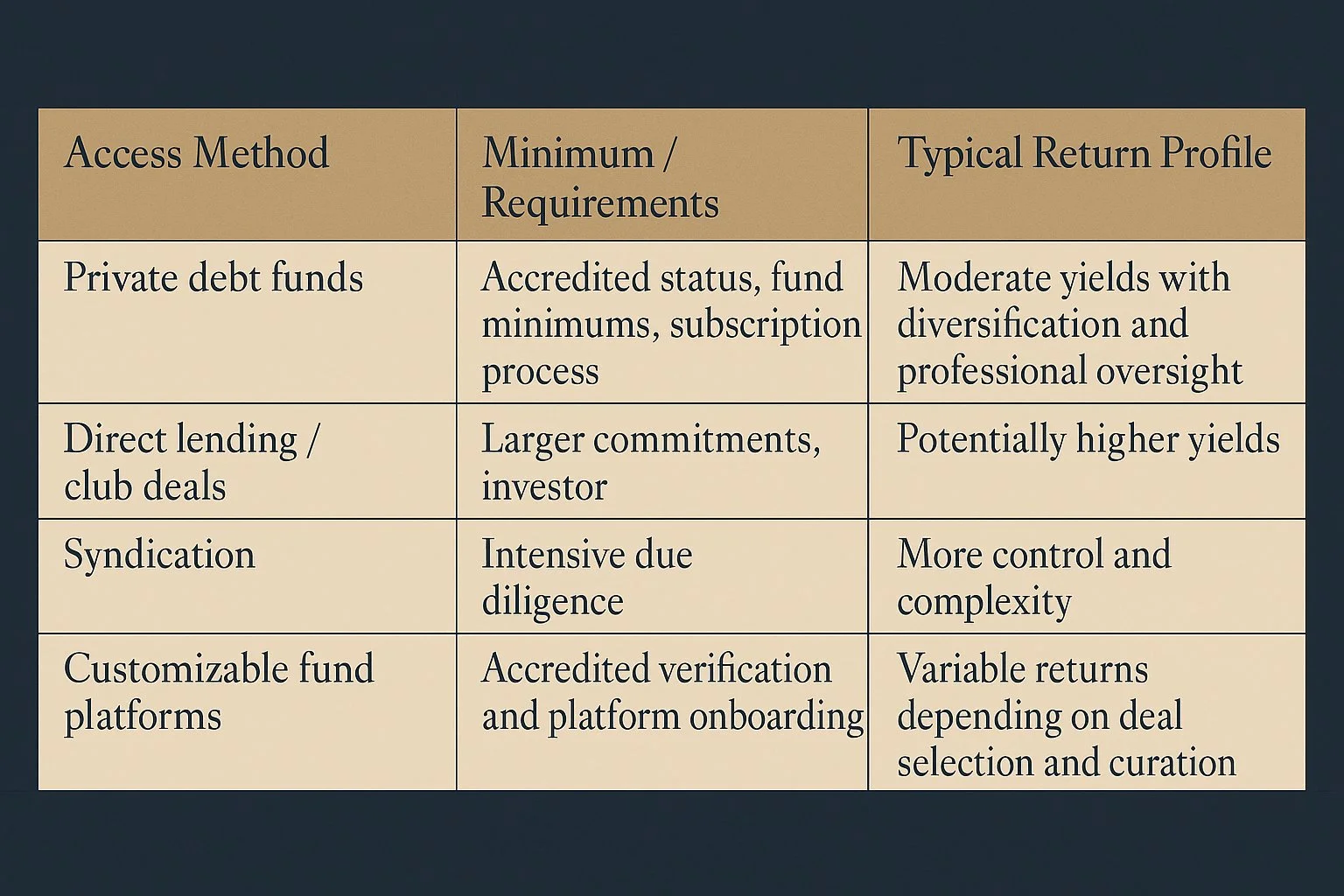
Accredited investors can access private credit through private debt funds, direct lending/club deals, and online customizable fund platforms. Funds pool capital for professional underwriting and diversification. Direct lending offers greater control but demands deeper due diligence. Customizable fund platforms provide granular access and investor-determined risks and return exposure. Choose the channel that matches your capital, time commitment, and governance preferences.
The table below compares common access methods by requirements and expected return profiles to help you select an appropriate entry path.
What are the accredited investor requirements and platform onboarding steps?
Accredited investor status is a regulatory threshold, typically based on income or net worth, verified during onboarding. Expect to provide accreditation documentation, complete basic KYC, and sign subscription agreements before funding. Platforms set minimums and lock-up terms.
No broadcasts. No noise. Just outcomes.
How does private credit contribute to legacy building and values-aligned investing?

Private credit supports generational wealth by delivering steady, collateralized income streams for estate liquidity, philanthropic commitments, and intergenerational transfers with lower volatility than equities. Predictable coupons allow families to fund distributions or charitable gifts without selling long-term assets, while secured positions reduce sequence-of-returns risk. Faith-based stewardship guides manager selection, favoring conservative underwriting, transparent governance, and long-term thinking.
What makes Blue Bay Fund I’s real estate-secured private debt strategy stand out?
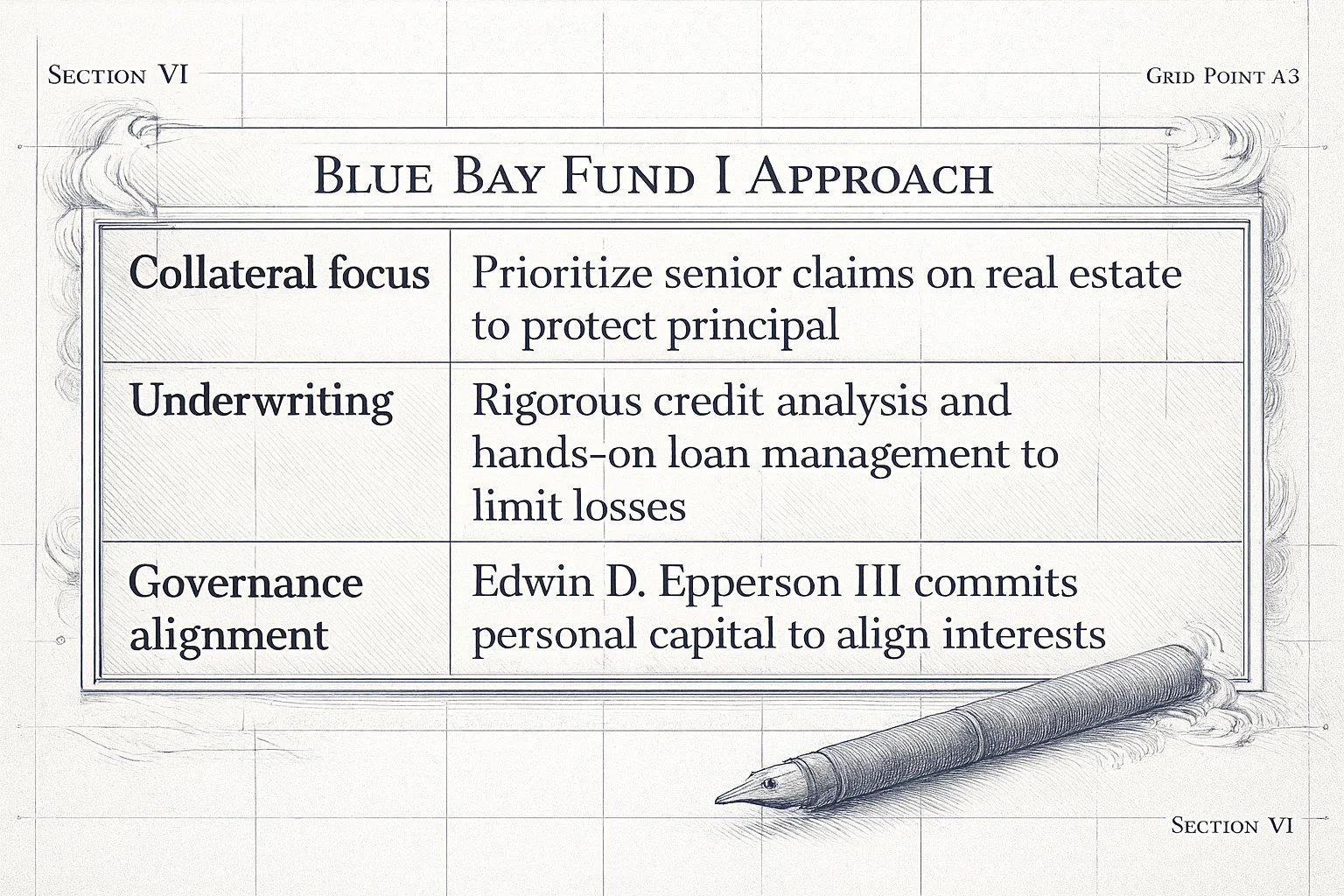
Blue Bay Fund I centers on real estate-secured private debt, using first-position mortgage notes as primary collateral and stability driver. The fund emphasizes conservative underwriting, disciplined loan-to-value limits, and active servicing to protect principal and generate dependable income.
Capital with Command
Founder Edwin D. Epperson III invests alongside clients, aligning incentives. The fund’s positioning combines disciplined leadership, faith-informed stewardship, and a purposeful lifestyle sensibility.
Real assets for real inheritance.
How can investors get started with private credit investments at Blue Bay Fund I?

Accredited investors interested in Blue Bay Fund I should expect a structured onboarding process: initial conversation, accreditation verification and KYC, subscription agreement execution, capital funding, and ongoing reporting. Prepare verification documents and a clear allocation plan to streamline the process.
Prepare accreditation documents: Gather income and net-worth verification and identity documents to speed onboarding.
Evaluate alignment and governance: Review management alignment, reporting cadence, and whether leadership invests alongside clients.
Assess liquidity and timelines: Understand lock-up periods, expected distributions, and how private credit fits your overall allocation.
Confirm underwriting standards: Request details on collateral policies, LTV limits, and servicing and workout procedures.
A process as refined as the capital it welcomes.
Frequently Asked Questions
What risks come with private credit investments?
Private credit carries credit risk (borrower default), illiquidity risk (limited exit ability), and market/collateral risk (asset value declines). Proper due diligence, conservative underwriting, and active servicing are essential.
How do interest rates affect private credit investments?
Interest rates influence borrowing costs and loan yields. Rising rates can increase borrower stress but also enhance yields on new loans. Managers typically structure terms and underwriting to account for rate cycles.
Why is diversification important in private credit investing?
Diversification reduces exposure to any single borrower, sector, or asset type. Spreading investments across loan types, industries, and geographies lowers the impact of individual defaults or localized downturns, helping stabilize returns.
Ready to Explore Private Credit for Your Portfolio?
Connect with Blue Bay Fund I to discuss how our disciplined, real estate-secured private debt strategy can align with your wealth preservation goals.
Conclusion
For accredited investors focused on preservation, private credit offers capital protection, predictable income, and yield enhancement, especially when loans are secured by real estate. Understanding private credit types, access routes, and manager selection helps build a preservation-first allocation. Working with disciplined, values-aligned managers like Blue Bay Fund I can provide structured access to conservative, founder-aligned strategies. Contact us to learn how private credit can fit into your wealth-preservation plan.
Disclaimer: This content is for informational purposes only and does not constitute financial advice, an offer to sell, or a solicitation to buy any securities. Private credit investments involve significant risks, including illiquidity, loss of principal, and potential for default. Past performance is not indicative of future results. Investors should conduct their own due diligence and consult with qualified financial, legal, and tax advisors before making any investment decisions. Blue Bay Fund I is available only to accredited investors who meet specific eligibility criteria.

Edwin D. Epperson III,
Manager & CEO
Soli Deo Gloria


