
Risk Control for Accredited Investors: Practical Strategies to Preserve Wealth and Secure Alternative Investments

Professional Photography: Carography Studios
Accredited investors shape private markets and routinely encounter opportunities that require disciplined risk control. This piece lays out clear, actionable strategies—focused on capital preservation and safety in alternative investments. We explain who qualifies as an accredited investor, the core risk-management tools available, and the practical approaches Blue Bay Fund I uses to limit downside. You’ll also find advanced preservation techniques, regulatory considerations, and how a disciplined investment philosophy reduces volatility and uncertainty.

Accredited investor status is not just access. It is the confidence of knowing your capital moves with intention, discipline, and protection
Who Qualifies as an Accredited Investor and Why Does It Matter for Risk Management?
Knowing who qualifies as an accredited investor matters because that status determines access to private deals—and the different risk profile those deals bring. The SEC’s definition signals both opportunity and responsibility: with wider access comes a need for stronger risk control and governance.
What Are the SEC Criteria Defining Accredited Investors?
The SEC sets specific financial thresholds for accredited investor status. Common criteria include a net worth over $1 million (excluding the primary residence) or an individual income above $200,000 in each of the last two years—with a reasonable expectation of similar income this year. In addition, certain professional certifications and credentials can qualify individuals, broadening access to private investment opportunities.
How Does Accreditation Influence Investment Opportunities and Risk Exposure?
Accreditation opens private equity, hedge funds, and non‑public real estate opportunities that often offer higher return potential but also greater risk and fewer public‑market protections. Effective risk management recognizes that trade‑off and builds guardrails—underwriting standards, diversification, and liquidity planning—before capital is committed.
What Are the Key Risk Management Strategies for Accredited Investors?
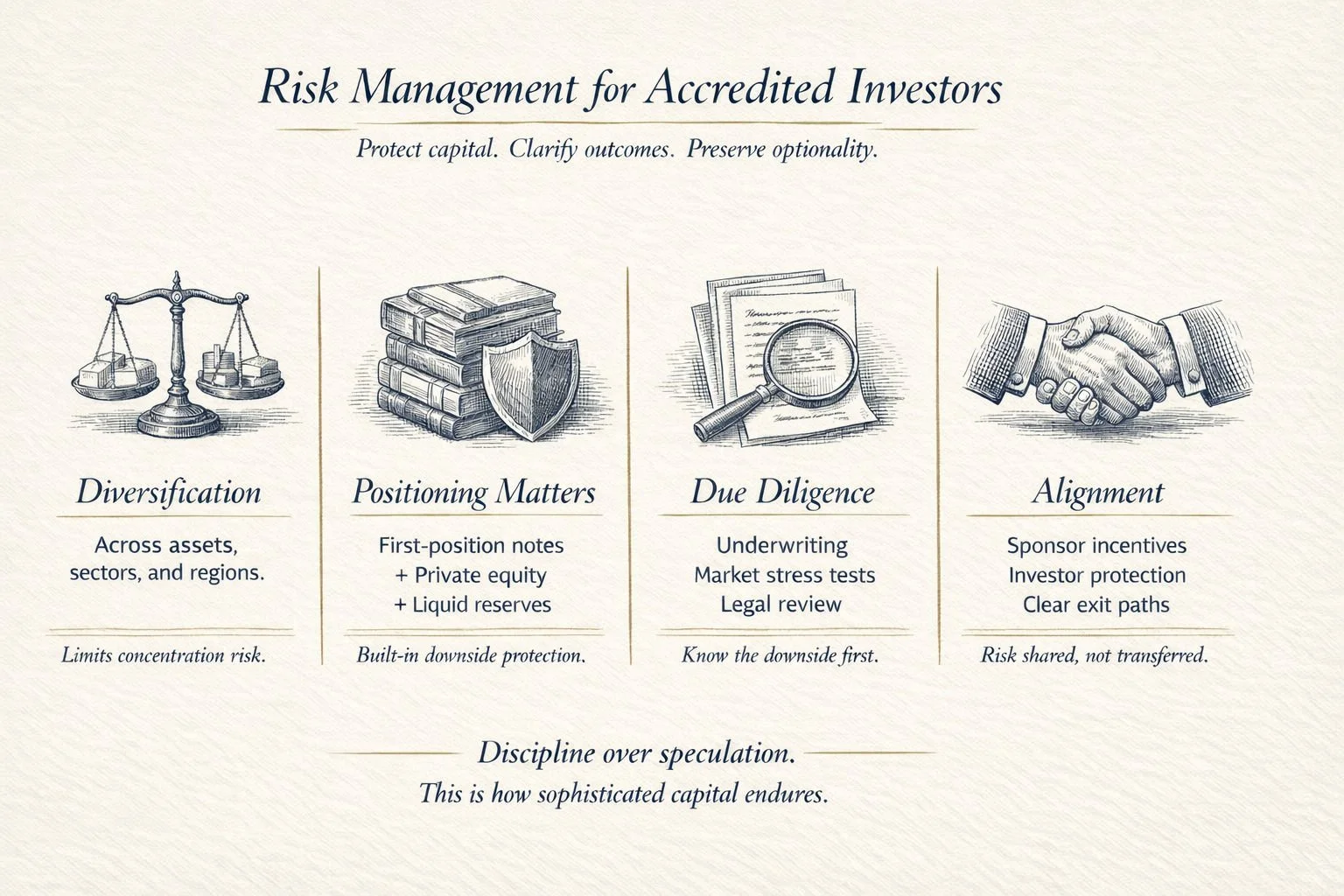
Confidence in Every Capital Decision
A disciplined framework designed to protect principal, reduce uncertainty, and let sophisticated investors move forward with clarity.
Accredited investors rely on a set of complementary strategies to protect capital and capture returns. These tools are designed to limit downside, clarify outcomes, and preserve optionality in changing markets.
How Does Diversification Mitigate Investment Risk in Alternative Assets?
Diversification reduces concentration risk by spreading capital across asset classes, sectors, and geographies. In alternatives, that might mean combining first‑position real estate notes with private equity and select liquid strategies—so underperformance in one area is less likely to derail overall results.
What Role Does Due Diligence Play in Private Credit and Real Estate Investments?
Thorough due diligence is non‑negotiable: financial underwriting, market analysis, legal review, and counterparty assessment all matter. The goal is to understand downside scenarios, stress‑test cash flows, and confirm alignment between sponsor incentives and investor protection before deploying capital.
The Modern Gentleman: Faith, Family, and Stewardship in Leisure
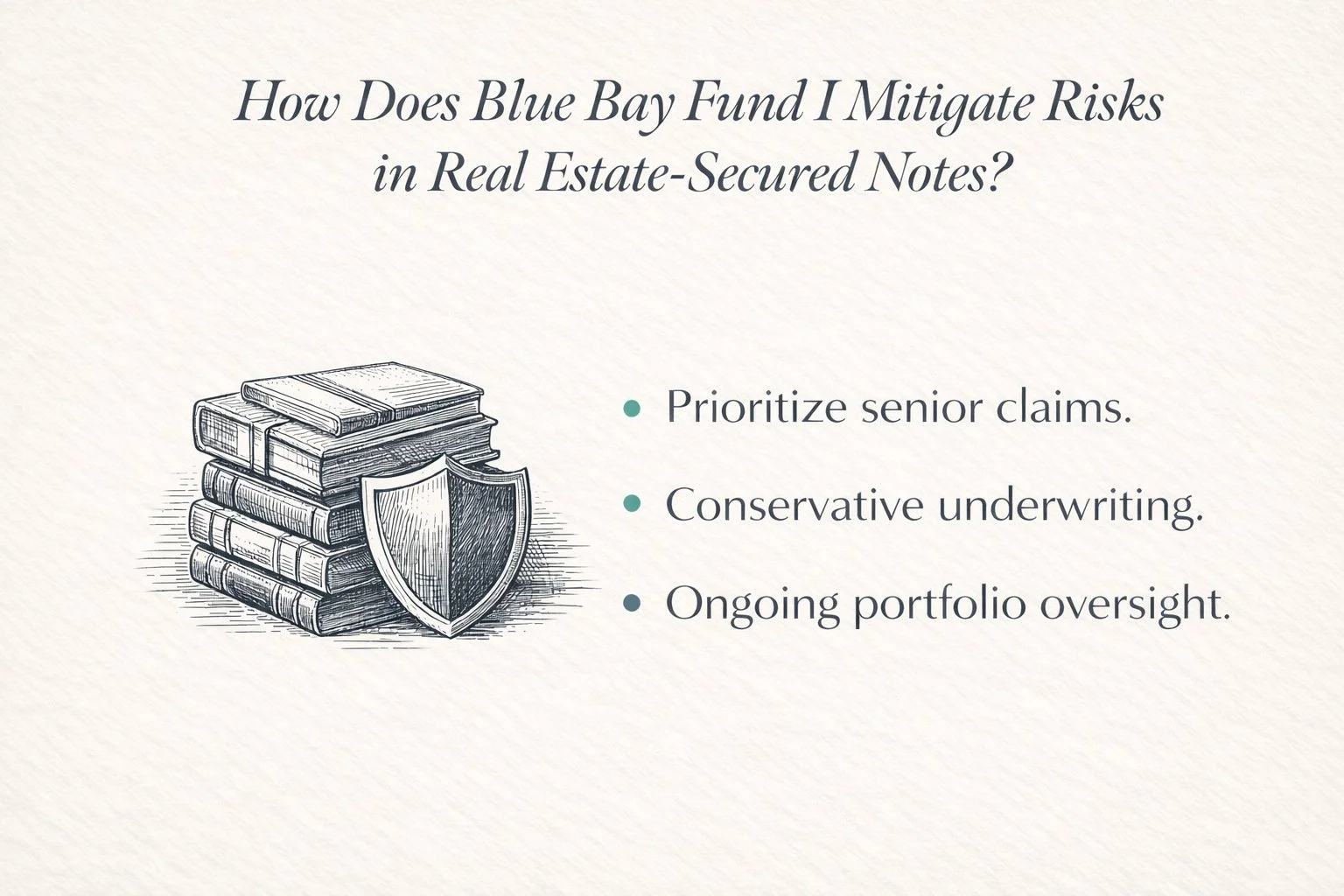
Blue Bay Fund I applies targeted controls to real estate‑secured notes with an emphasis on stability and capital preservation. Our process prioritizes senior claims, conservative underwriting, and ongoing portfolio oversight to limit losses and protect principal.
What Is the Importance of First-Position Mortgage Notes in Risk Control?
First‑lien mortgage notes give investors the primary legal claim on property collateral if a borrower defaults. That senior position materially improves recovery prospects and narrows downside—one reason senior, well‑underwritten notes are a core component of capital‑preservation strategies.
How Does Conservative Underwriting Enhance Capital Preservation?
Conservative underwriting limits exposure by setting disciplined loan‑to‑value targets, validating cash flows, and applying stress tests to key assumptions. By selecting borrowers and properties that meet strict financial and structural standards, Blue Bay Fund I reduces default risk and supports steadier returns over time.
Academic and industry research similarly show that tight underwriting criteria—especially in commercial real estate—drive safer leverage decisions and better risk outcomes.
Commercial Real Estate Underwriting & Risk Management
Risk‑averse commercial mortgage lenders follow underwriting policies with strict limits tied to a property’s value and projected cash flow. Borrowers choose loan amounts and amortization schedules that fit those limits to maximize net present value. When underwriting is based on standard mortgage ratios, the optimization has a closed‑form solution. Applied to loan data, changes in market parameters and cash‑flow‑based policy limits explain much of the variability in initial leverage. This supports the view that initial leverage is determined within the underwriting process, while forward‑looking and cash‑flow measures are primary drivers of commercial loan risk management.
Underwriting limits and optimal leverage in commercial real estate, 2020
What Are Proven Capital Preservation Strategies Used by Sophisticated Investors?
Sophisticated investors layer traditional approaches with targeted techniques to defend purchasing power and limit volatility. These strategies are chosen to fit an investor’s time horizon, liquidity needs, and risk tolerance.
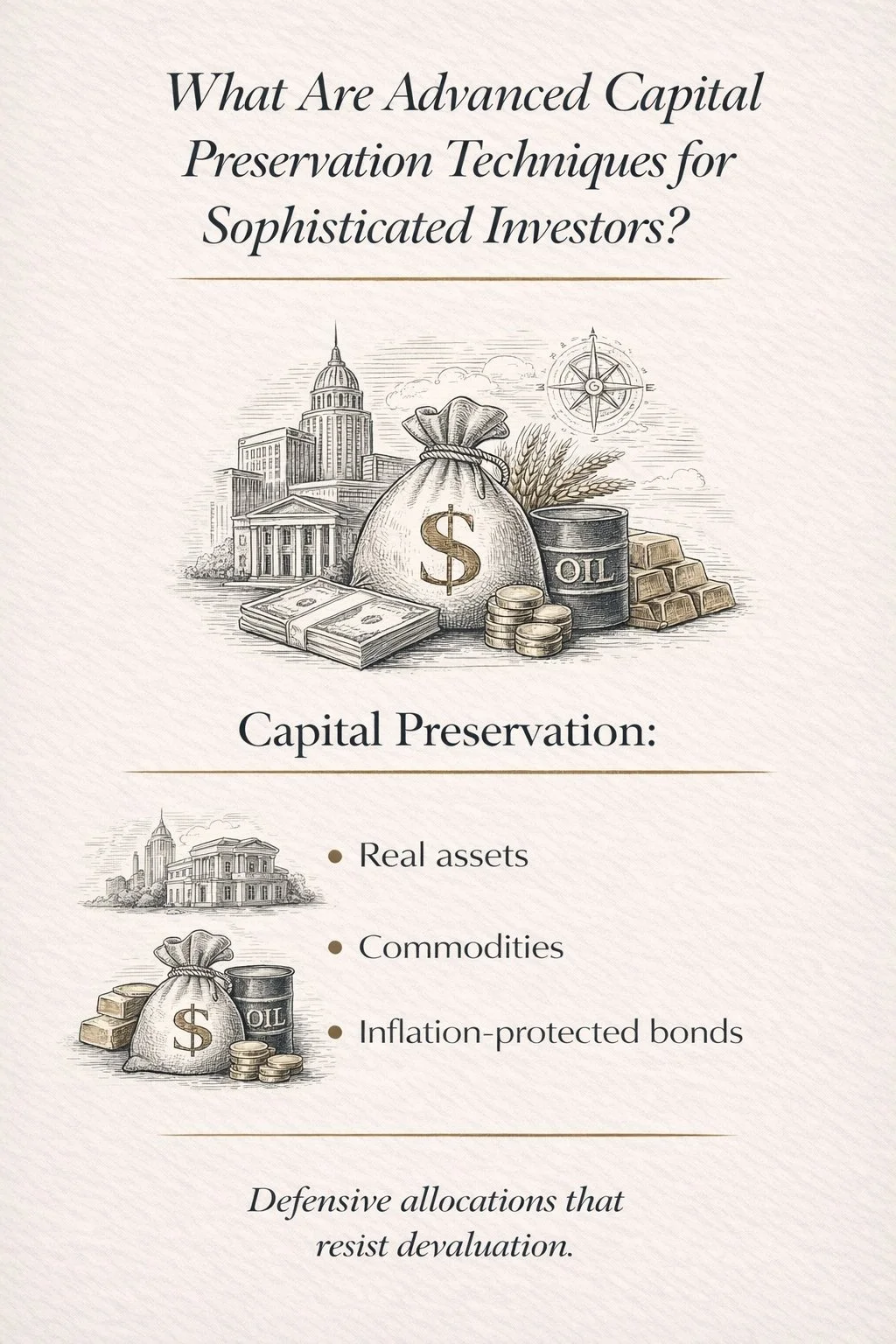
How Can Accredited Investors Protect Wealth Against Market Volatility and Inflation?
To guard against volatility and inflation, consider allocations to real assets (real estate), commodities, and inflation‑protected securities such as TIPS. These holdings can act as hedges in downturns and preserve real purchasing power over time when paired with a diversified portfolio.
What Are the Benefits of Collateralized Debt Investments in Risk Mitigation?
Collateralized debt ties credit exposure to tangible assets, so recovery prospects improve if a borrower defaults. That structural protection can produce steadier returns and lower credit loss risk compared with unsecured credit, making secured debt an attractive building block for preservation‑focused portfolios.
The Advantage of Accredited Status

Photography: Carography Studios
Regulation shapes what investors can access and the disclosures they receive. Understanding the framework helps investors evaluate protections, compliance needs, and the trade‑offs inherent in private markets.
What SEC Regulations Govern Accredited Investor Investments?
The SEC’s rules, including Regulation D, govern many private offerings and disclosure requirements. Those rules limit broad public solicitation and focus sales to investors who meet accredited criteria—so staying current on these regulations is essential for compliant investing in private securities.
The Regulation D framework remains central to who can participate in private markets and the level of investor protections available.
SEC Regulation D & Accredited Investor Definition
The SEC’s Regulation D limits many private company securities offerings to accredited investors. The accredited investor definition under Regulation D has generated ongoing debate about who should qualify and whether additional vetting—such as an exam—should be adopted.
SEC Regulation D & Accredited Investor Definition
How Can Investors Navigate Compliance in Private Market Securities?
Compliance in private markets can be complex. Work with experienced legal and tax advisors, insist on clear disclosure from sponsors, and document your suitability and accreditation evidence. Proactive governance reduces legal and operational risk and supports better long‑term outcomes.
How Does a Discipline-Driven Investment Philosophy Enhance Risk Management?

A discipline-driven investment philosophy anchors decision‑making and prevents emotional reactions to short‑term market moves. Discipline ensures consistency in underwriting, portfolio construction, and exit planning—key ingredients in reliable risk control.
What Lessons from Military Discipline Apply to Wealth Preservation?
Military discipline teaches focus, preparation, and adherence to standards—qualities that translate well to investing. Keeping to a documented plan, enforcing preset risk limits, and preparing for contingencies help investors avoid impulsive choices that erode capital over time.
How Does Stewardship Influence Long-Term Risk Control Strategies?
Stewardship means managing capital with an eye to long‑term durability. Prioritizing sustainable growth, aligning incentives with stakeholders, and focusing on responsible underwriting all support resilient portfolios that serve investors across cycles.
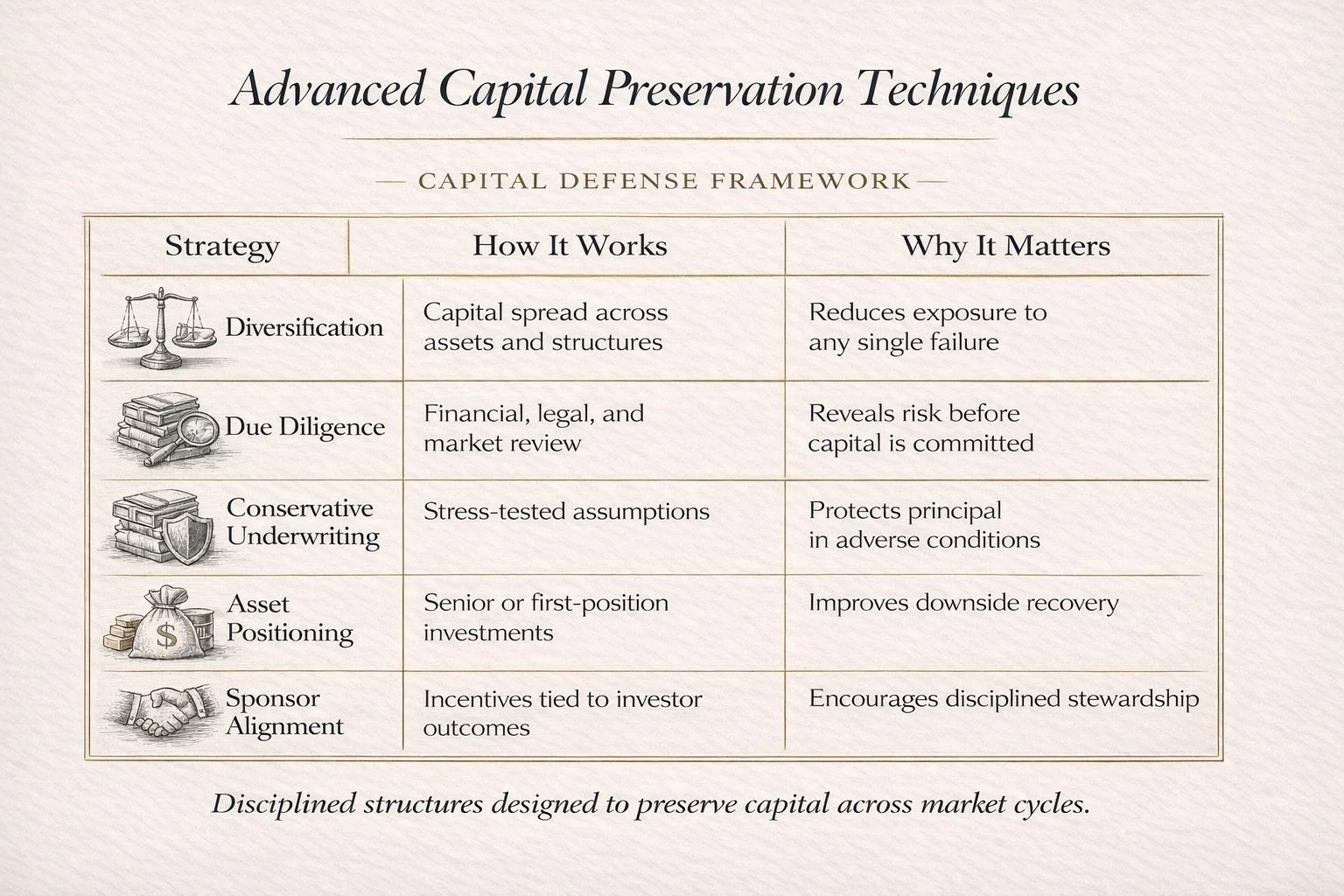
Combined, these practices form a disciplined framework for managing risk in private markets—helping accredited investors pursue returns while protecting principal.
Frequently Asked Questions
What are the benefits of working with financial advisors for accredited investors?
Advisors bring specialized market knowledge, due‑diligence capabilities, and experience structuring private investments. They help align strategies with your goals, document suitability and compliance, and provide discipline during turbulent markets—making it easier to stick to a long‑term plan.
How can accredited investors evaluate the performance of their investments?
Track quantitative metrics such as return on investment (ROI), cash flow, and benchmark comparisons, and review qualitative factors like sponsor track record and market conditions. Regular reporting and analytics tools help spot trends and inform rebalancing or exit decisions.
What are the risks associated with private equity investments for accredited investors?
Private equity carries illiquidity, longer holding periods, valuation uncertainty, and operational risks. Transparency can be limited versus public markets. Mitigate these risks with thorough due diligence, diversified exposure, and realistic time horizons.
How does market sentiment affect investment decisions for accredited investors?
Sentiment can create short‑term price swings and affect deal flow. While useful as a market signal, sentiment should be balanced with fundamental analysis to avoid reactive decisions that undermine long‑term objectives.
What strategies can accredited investors use to enhance liquidity in their portfolios?
Maintain a portion of assets in cash or cash equivalents, allocate to publicly traded securities, or use liquid alternative strategies. Some investors also arrange lines of credit secured by portfolio assets to access capital without forced sales.
What role does asset allocation play in risk management for accredited investors?
Asset allocation is the primary lever for balancing risk and return. By spreading capital across equities, fixed income, real assets, and alternatives, investors can align portfolios with their risk tolerance, time horizon, and liquidity needs—helping preserve wealth across market cycles.
Conclusion
Accredited investors improve the odds of preserving wealth when they combine disciplined underwriting, rigorous due diligence, and diversified portfolio construction. Stay informed about regulatory changes and partner with experienced advisors to keep risk controls current. Explore our resources for deeper insight and practical tools to refine your investment strategy.

Edwin D. Epperson III,
Manager & CEO
Soli Deo Gloria


